
Battery Thermal Management Systems (BTMS) and Heat Pumps in Chinese EVs: Extreme Climate Procurement Guide
Compare Chinese EV battery thermal management and heat pumps for hot and cold fleets. Use the RFQ checklist to verify cooling, preconditioning and compliance.
Chinese EV battery thermal management determines how a vehicle manages battery heat during driving, charging and parking. For fleet buyers, a heat pump badge or peak charging figure cannot establish whether the vehicle will complete a desert delivery shift or a winter route. Request evidence for the exact model year, battery, trim, software version and destination-market specification.
This guide compares direct refrigerant cooling, liquid-coolant loops and heat pump heating, then turns those differences into RFQ questions and acceptance checks. It covers global commercial importers, distributors and engineering teams evaluating Chinese EVs for hot or cold climates; it does not rank brands by unverified thermal performance.
Quick procurement answer: buy against a documented duty cycle, demonstrated preconditioning controls, destination-compatible refrigerant and an obtainable service-fluid specification. Confirm heat pump equipment at VIN level and validate repeated charging with cabin HVAC running. Neither 800V branding nor the name of a battery chemistry proves climate suitability.
Already have a shortlist? Send your models, destination and daily duty cycle for a sourcing inquiry, using the checklist below to identify the evidence you need from suppliers.
Published and reviewed: October 25, 2026. Method and limits: this is a desk-based procurement framework using the sources listed below, basic energy arithmetic and proposed acceptance checks. We have not conducted comparative vehicle tests for this article. Numerical examples are explicitly assumed inputs, not measured OEM results. Destination approval, OEM operating limits and service instructions must be confirmed for the vehicle being purchased.
1. Executive Summary & Key Procurement Conclusions
Before committing capital to vehicle allocations, verify four points:
- Cooling architecture is a starting point: request the refrigerant and coolant circuit diagrams, plus repeated-charge results. A direct refrigerant plate or a glycol chiller does not by itself establish temperature uniformity, durability or cooling capacity.
- A heat pump is useful only within its operating envelope: ask for heating output and total electrical demand at your design conditions, including defrost, battery heating and any supplemental Positive Temperature Coefficient (PTC) heater. A cabin heat pump does not necessarily preheat the battery.
- Specify hot-climate outcomes: require charge-session duration, cabin comfort and power availability after repeated driving and charging. Compressor displacement alone is an inadequate purchase criterion.
- Verify fluids and approval separately: inspect the factory refrigerant label and OEM coolant part number, then check destination requirements. A refrigerant label is not proof of registration eligibility.
2. Core BTMS Architectures in Chinese EVs
Battery Thermal Management Systems (BTMS) heat or cool the traction battery. Depending on the vehicle, their circuits may share components with cabin HVAC and electric powertrain cooling. Integration can recover waste heat, but it also makes controls, service procedures and competing loads relevant to fleet operation.
Treat these as functions to verify, rather than generations inferred from a platform badge:
Battery heat path: cells -> cold plate -> refrigerant or liquid coolant
Heat rejection: refrigerant/coolant -> heat exchanger -> outside air
Heating sources: PTC heater and/or heat pump, with available waste heat
Controls: temperature sensors -> BMS/HVAC controller -> pumps, valves, compressorConceptual heat paths only: the diagram omits return lines, pumps and cabin branches. It is not an OEM plumbing or service schematic.
2.1 Direct Refrigerant Expansion vs. Indirect Liquid Loops
Direct refrigerant cooling uses an evaporator plate to exchange heat between the battery and refrigerant. It can reduce the need for a separate battery coolant circuit, but the vehicle may still have other liquid loops. Ask where the plate sits, how leaks are isolated and which repairs require battery removal. Neither the Blade Battery name nor a shared platform name establishes the exact arrangement for every model.
Indirect liquid cooling circulates OEM-approved coolant through a battery cold plate. A chiller exchanges heat with the refrigerant circuit when active cooling is needed; other operating modes may use a radiator or heater. Pumps, valves, hoses and bleeding procedures become part of the service plan. Coolant channels may be inside the battery enclosure, so a coolant leak is not necessarily external or harmless.
Selection rule: compare the documented duty-cycle results and local service requirements. Neither architecture guarantees a particular cell-temperature spread, lower weight or longer life without model-specific evidence. Obtain minimum and maximum measured battery temperatures under the same test conditions before comparing suppliers.
3. Extreme Hot Climate Performance: Desert & High Ambient
A useful hot-climate RFQ describes ambient temperature, solar exposure, payload, speed, gradients, cabin set point and charging schedule. For example, 45°C ambient is a proposed test condition, not a universal threshold at which EVs fail. Agree conditions that represent the intended destination and stay within OEM operating instructions.
3.1 Repeated DC Fast Charging and Thermal Derating
Peak charging power does not establish depot throughput. Charging can be limited by state of charge (SOC), battery temperature, charger capability, software or battery protection. Do not label every slow session a cooling fault.
A basic electrical screening calculation is P_loss = I² × R. If the assumed equivalent pack resistance is 0.05 ohm and current is 400 A, resistive heating is 400² × 0.05 = 8,000 W, or 8 kW. This simplified example excludes other heat sources and is not a chiller sizing recommendation: effective resistance and cooling demand vary with SOC, temperature and pack design. At a fixed electrical power, higher voltage reduces current; that alone cannot establish battery cooling performance.
Proposed supplier acceptance process:
- Identify the VIN/build specification, software version and OEM temperature limits. Agree the required repetitions and acceptance values before testing.
- Log initial SOC, battery temperature readings, ambient conditions and charger power/current limits.
- Drive the representative route with the agreed payload and cabin HVAC settings. Record cooling demand or relevant diagnostic readings where available.
- Repeat the agreed charging window after the route. Record the complete power-versus-time trace, energy delivered, elapsed time, battery temperatures and any warnings.
- Compare sessions under equivalent conditions. Investigate charger limitations and SOC differences before attributing a slower session to the BTMS.
Reject an unsupported headline charging time as acceptance evidence. Use a witnessed log or an OEM report with a reproducible method, agreed route reserve and maximum permissible turnaround time.
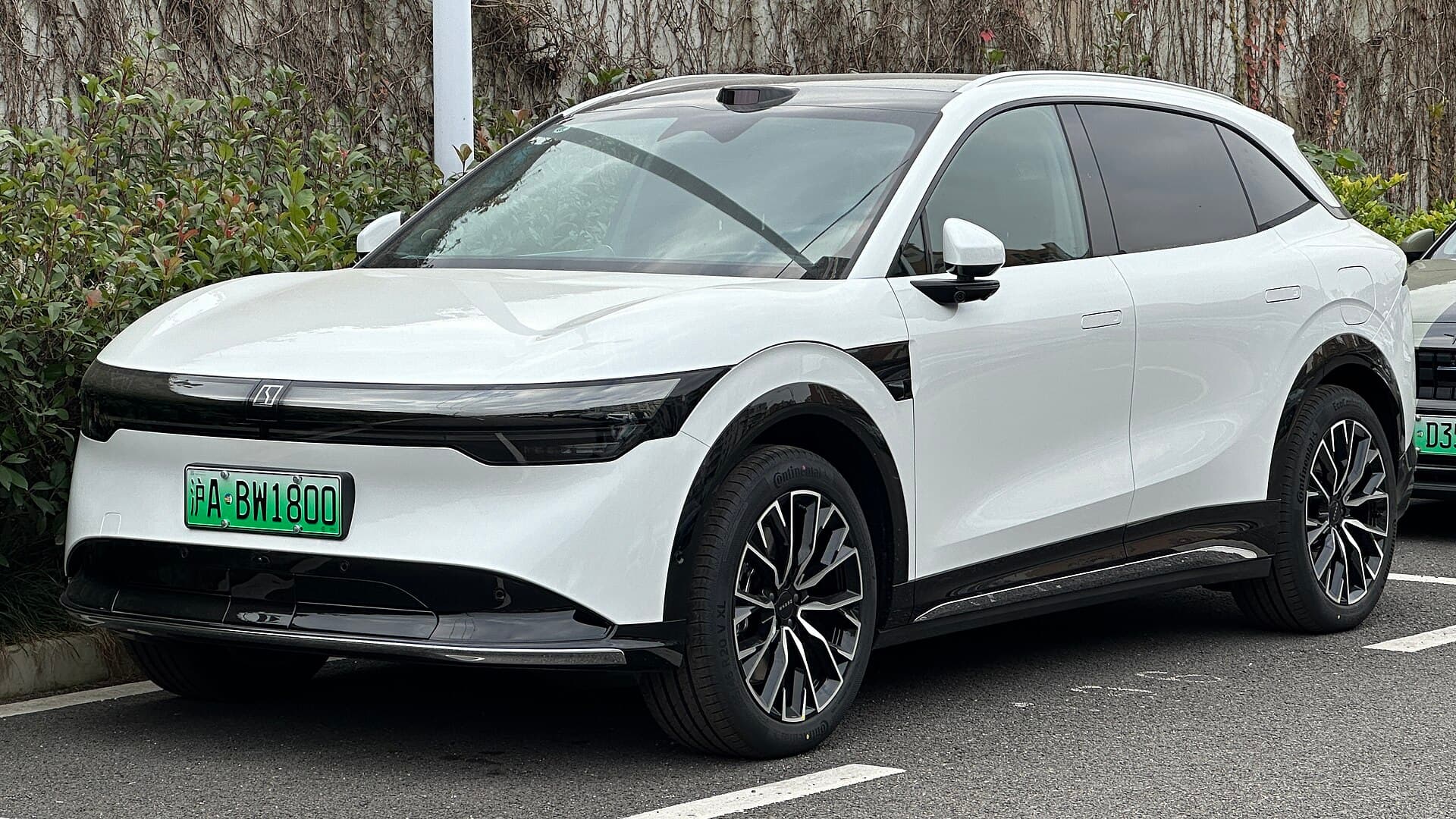
Vehicle illustration only. This photograph does not establish the pictured vehicle's cooling architecture, refrigerant or measured climate performance.
3.2 Cabin vs. Battery Cooling Priorities
Shared HVAC hardware can serve competing loads. Ask how the controller allocates cooling during stationary charging, low-speed operation and high-load driving. Require results with the cabin occupied or with an agreed simulated load; a cabin-off charging demonstration may not represent fleet use.
Do not specify a universal compressor displacement or chiller kilowatt minimum without operating conditions. Capacity ratings need the refrigerant, ambient temperature, coolant flow and inlet/outlet temperatures. Assess route completion, cabin comfort and repeated-charge duration together.
4. Extreme Cold Climate Performance: Heat Pump vs. PTC
Cold weather affects both energy consumption and available battery performance. The DOE/EPA cold-weather guide identifies cabin heating as a substantial contributor and recommends plugged-in preheating where supported. Its cited EV estimates use an older study; they are not forecasts for a current Chinese model or proof of a particular heat pump saving.
4.1 Heat Pump COP and a Reproducible Energy Example
Coefficient of Performance (COP) is useful heat delivered divided by electrical input. A resistive PTC heater converts electrical energy to heat at approximately COP 1 at the heater boundary. A heat pump moves heat and can exceed COP 1, but its delivered output and whole-system efficiency depend on ambient conditions, humidity, defrost cycles, available waste heat and supplemental heating.
Illustrative assumptions only: a constant 6 kW heating demand, a two-hour 100 km route, 20 kWh traction consumption, 70 kWh usable energy, and an assumed heat pump COP of 2. No ambient temperature or OEM performance is implied.
| Calculation input or result | PTC example | Heat pump example |
|---|---|---|
| Useful heat demand, assumed constant | 6 kW | 6 kW |
| COP, assumed | 1 | 2 |
| Electrical heating power: heat demand / COP | 6 kW | 3 kW |
| Heating energy for two hours | 12 kWh | 6 kWh |
| Traction energy for 100 km, assumed | 20 kWh | 20 kWh |
| Total energy for 100 km | 32 kWh | 26 kWh |
| Calculated range: 70 / consumption × 100 | About 219 km | About 269 km |
The example saves 6 kWh per 100 km and calculates about 50 km more range under those assumptions. It is not a winter range prediction: it excludes cold-related changes in usable energy, battery warm-up, wind, road conditions and reserve. Replace all inputs with supplier test data for the same route and boundary before making a purchase decision. Request both heat output and electrical input, not a COP number alone.
4.2 Battery Preconditioning and Export Software
Battery preconditioning prepares the pack for charging or driving; cabin preheating is a separate function. Cold charging requires model-specific current and temperature controls. Procurement teams should verify the OEM's permitted operating range and the vehicle's ability to condition the battery without bypassing BMS protections.
Route-based preconditioning may depend on navigation, charger recognition or connectivity. Do not assume that it always fails abroad, or that every model has a manual override. Demonstrate the function on the intended software build with destination maps and connectivity conditions. See the parallel import software and OTA guide for related access questions.
Ask the supplier to demonstrate: the activation method, any SOC or temperature prerequisites, whether the battery actually warms, and the resulting charging behavior. A menu screenshot alone does not establish functionality.
5. Chinese EV Supplier Comparison: Evidence to Request
The following seven-row matrix is an RFQ worksheet, not a verified specification or performance ranking. Names identify purchasing shortlists. Hardware, battery suppliers, heating equipment and refrigerant can change by year, trim and market; the sources below do not certify these configurations.
| Purchasing shortlist | Configuration to identify | Heating evidence to request | Cooling evidence to request | Export/service check |
|---|---|---|---|---|
| BYD Seal / Atto 3 / Dolphin | Exact model year, battery and market build | Heat pump fitment and battery heating method | Battery plate/circuit diagram and repeated-charge log | Factory refrigerant label and approved repair procedure |
| Zeekr 001 / 007 / 7X | Model revision, battery option and software | Low-temperature heat output and supplemental heater operation | Temperature readings across consecutive charge sessions | Destination preconditioning access and coolant part number |
| Xpeng G6 / G9 / X9 | Market version and battery/trim code | Heat pump equipment list and cold-route energy log | Cabin-on hot-charge test report | Navigation dependencies and local diagnostic access |
| Li Auto L7 / L8 / L9 | Exact range-extended configuration | Heating behavior with engine running and engine off | Battery cooling during electric and range-extended operation | Fuel and electricity consumption; service support for both systems |
| Deepal SL03 / S07 | BEV or range-extended variant | Battery heating method and activation conditions | Route-specific charging and temperature log | Software behavior and approved consumables |
| Chery Exeed / Exlantix shortlist | Exact model, powertrain and destination specification | Heat pump availability and cold-start documentation | Full charging trace at the agreed ambient conditions | Refrigerant, diagnostics and service documentation |
| MG4 EV / MG Cyberster | Trim, model year and country specification | Written heat pump fitment confirmation | Cooling circuit and repeated-use results | Local coolant/refrigerant service capability |
For cold routes, prioritize demonstrated heating and preconditioning over a platform label. For hot routes, prioritize the repeated-charge test with cabin HVAC operating. For remote deployments, give service access and consumable availability equal attention. Range-extended vehicles still need a winter energy assessment; engine heat does not mean zero seasonal penalty.
For help turning a shortlist into supplier questions, send a climate-specific RFQ with ambient extremes, route length, payload and charger details.
6. Refrigerant, Coolant and Destination Requirements
6.1 Refrigerant Verification Is Separate from Registration Approval
Check the under-hood refrigerant label against the VIN/build documentation, including refrigerant identity, charge quantity and compressor lubricant specification. R134a, R1234yf and R744 are different refrigerants; do not infer which one is fitted from a domestic/export label alone.
For an EU destination, consult the Mobile Air Conditioning Directive 2006/40/EC and the F-gas Regulation (EU) 2024/573. The MAC framework and wider F-gas obligations have different scopes. Confirm the current requirements for the vehicle category, approval route, registration history and refrigerant handling with the destination approval authority before contracting. Other destinations, including the UK, need their own checks; participation in a UNECE approval framework does not establish identical refrigerant rules.
A refrigerant label alone cannot establish customs clearance or registration eligibility. Do not assume a refrigerant conversion will make an otherwise ineligible vehicle approvable. Refrigerants and oils are not interchangeable; obtain an OEM-authorized repair or conversion procedure and local approval advice before committing to such work.
6.2 Coolant Chemistry: Follow the OEM Specification
Request the OEM coolant part number, technical specification, concentration, freeze protection, replacement interval and filling/bleeding procedure. Where conductivity limits apply, obtain the specified measurement conditions and service limits. There is no universal conductivity threshold or coolant formulation for every Chinese EV battery circuit.
An OAT corrosion-inhibitor description does not by itself establish electrical properties or compatibility. Glycol coolant is not automatically a dielectric immersion fluid. Do not mix fluids based on color, a generic antifreeze label or a supplier's verbal assurance. Confirm an obtainable, approved replacement before shipment and have leaks investigated using OEM procedures.
7. Failure Symptoms and Procurement Mitigations
These are diagnostic questions and proposed checks, not measured failure rates or guaranteed outcomes.
| Symptom | Possible contributors | Evidence needed | Procurement response |
|---|---|---|---|
| Later charge sessions take longer | SOC, charger limits, pack temperature or cooling control | Comparable charge traces and battery temperature logs | Set a repeated-session turnaround requirement |
| Winter route reserve is insufficient | Cabin demand, cold pack, route load or reduced usable energy | Same-route energy and SOC log with heating settings | Agree a minimum arrival reserve under the defined conditions |
| Battery heating is unavailable abroad | Software configuration, connectivity or unmet activation conditions | Destination-condition demonstration on the ordered build | Require a documented, usable conditioning method |
| Coolant level drops or thermal warnings appear | Leak, air in circuit, pump or sensor fault | OEM diagnostic and pressure/bleed procedure | Confirm repair tools, consumables and warranty handling |
| Drive power is restricted in heat | Battery or powertrain protection; cooling or sensor issue | Diagnostic codes, temperatures and route conditions | Require route completion within OEM limits |
| Refrigerant/service documents conflict | Build variation, incorrect paperwork or prior servicing | Label photograph, VIN record and service history | Resolve discrepancies and destination applicability before acceptance |
8. Procurement & Engineering Technical Checklist
Use this checklist before signing off the climate specification. Acceptance thresholds should be agreed for the intended duty cycle, not copied from an unrelated model.
Climate & Hardware
- Identify the exact vehicle: record model year, trim, battery, destination build, VIN or binding build code, and software version.
- Verify heating equipment: obtain the heat pump and supplemental heater equipment list; distinguish cabin heating from battery conditioning.
- Define the test envelope: agree ambient conditions, payload, route, cabin setting, SOC window, charge repetitions, arrival reserve and maximum turnaround time.
- Obtain usable evidence: retain complete route/charge logs and temperature readings; require exceptions and test conditions to be stated.
- Demonstrate preconditioning: test its prerequisites and activation on the intended destination software/connectivity setup.
Fluids, Approval & Service
- Check the refrigerant label: match identity, charge and lubricant specification to the build record; confirm destination applicability separately.
- Secure coolant specifications: confirm approved part numbers, mixture, service procedure and local supply; avoid generic conductivity requirements.
- Check environmental limits: obtain the relevant enclosure/connector protection and cleaning instructions. Ingress ratings do not prove climate durability or authorize arbitrary pressure washing.
- Confirm diagnostic access: establish which temperature channels and fault codes the local workshop can read. Consult the spare parts and diagnostics guide for service planning.
- Agree responsibility: document warranty territory, parts lead times, workshop capability and the remedy for a failed acceptance test.
FAQ
Does every Chinese EV with a heat pump preheat its battery?
No. Cabin heating and battery conditioning are different functions. Ask for the thermal circuit description and demonstrate battery conditioning on the exact trim and software version, including its activation prerequisites.
Is an 800V EV guaranteed to charge quickly in desert heat?
No. Voltage alone does not establish cell temperature, cooling capacity, charger availability or charging time. Compare repeated sessions over the same SOC window with cabin HVAC operating and document any power limits.
How much winter range does a heat pump save compared with PTC heating?
There is no single percentage for all vehicles or climates. The worked example assumes COP 2 and calculates about 50 km more range from a 70 kWh usable pack; it is arithmetic, not vehicle test data. Obtain same-route measurements including defrost, supplemental heating and battery warm-up.
Is direct refrigerant cooling better than a liquid-glycol loop?
Neither label establishes a winner. Compare measured temperatures, repeated-charge duration, leak-service procedures and local repair support for the exact vehicle. A battery chemistry or platform name cannot substitute for those records.
Can a domestic-market vehicle with R134a be registered in Europe?
Do not decide from the refrigerant label alone. Confirm the destination's current requirements, vehicle category, registration history and approval route with the approval authority. Neither a refrigerant change nor an exporter's assurance guarantees registration eligibility.
Can ordinary automotive antifreeze be used for a battery coolant top-up?
Use only a fluid approved for that vehicle and circuit, following the OEM mixing and filling instructions. Color or an OAT label does not establish compatibility. Investigate a falling level rather than repeatedly topping up an unexplained leak.
What should a fleet do before leaving EVs parked in severe cold?
Follow the model-specific storage temperature, SOC and charging instructions. Where supported, plugged-in preheating can reduce departure energy demand, as the DOE/EPA guide explains. Do not assume every vehicle automatically keeps its pack warm while plugged in, and never bypass its charging protections.
Next Steps for a Climate-Specific Vehicle RFQ
A useful thermal specification links the vehicle build to the route, the acceptance method and the service plan. Keep unverified hardware claims and illustrative calculations separate from supplier acceptance evidence.
Contact China EV Exporter with your shortlist and climate requirements. Include the destination, ambient extremes, daily distance, payload, charging schedule and required documentation so the inquiry can address the relevant supplier questions. You can also browse the Chinese EV export catalog to assemble a shortlist; a catalog listing alone does not verify climate suitability.
Sources & References
These sources provide market context, cold-weather guidance and regulatory starting points. They do not verify the equipment or thermal performance of the named models. No vehicle tests or customer outcomes are claimed in this article.
- IEA, Global EV Outlook 2026: Electric vehicle batteries — background on battery chemistries, markets and supply chains; not evidence of model-specific COP or cooling performance.
- U.S. DOE/EPA, Fuel Economy in Cold Weather — general winter efficiency and plugged-in preheating guidance; its EV estimates are based on a 2019 study, not this article's Chinese EV shortlist.
- EU Directive 2006/40/EC: Mobile Air Conditioning — reference for destination-specific mobile air-conditioning applicability; obtain current approval advice for the vehicle concerned.
- EU Regulation 2024/573: Fluorinated Greenhouse Gases — reference for applicable F-gas obligations; distinct from vehicle-specific registration approval.
Author

Categories
More Posts

Brake-by-Wire in Chinese EVs: One-Box EHB, Dry EMB, GB 21670-2025, and UN R13-H Homologation Procurement Guide
Compare Chinese EV brake-by-wire, One-Box EHB and dry EMB. Check GB 21670-2025, UN R13-H evidence and workshop readiness before requesting a vehicle RFQ.

China EV Export Market Update (2026-W27): EU-China Tariff Consultations, July 1 Process Gates, and Spare Parts Customs
China EV export update (2026-W27): EU-China TIC, AU ROVER motive-power, EU €3 parcel duty, UK eCoC Nov 29 shift, and Maersk U37.
LFP vs. NMC Batteries in Chinese EVs: A Procurement and Climate Adaptation Guide
LFP vs. NMC batteries guide for choosing Chinese EV packs by fleet climate, cycle life, safety, and import procurement risk. Audit your shortlist before RFQ.