
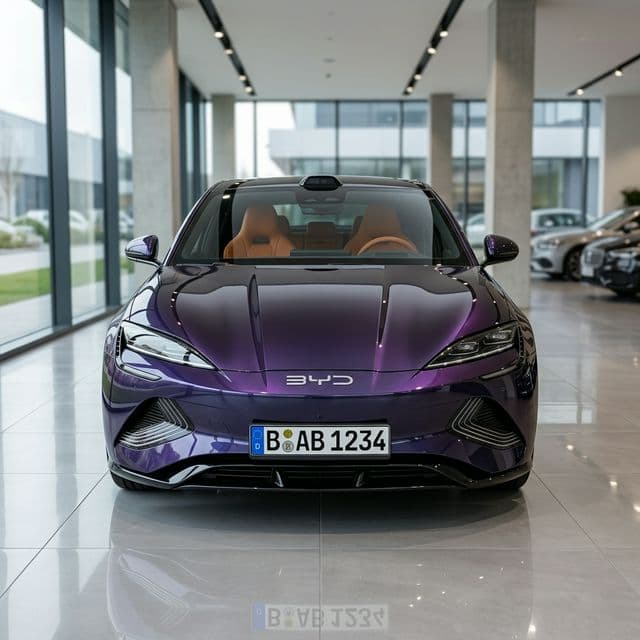
Cell-to-Body (CTB) and Megacasting in Chinese EVs: Structural Repairability, Insurance Underwriting, and Fleet TCO Procurement Guide
Assess Chinese EV CTB and megacasting repairability before fleet orders. Use evidence gates for body repair, battery service and insurance; request a review.
Cell-to-Body (CTB) and megacasting in Chinese EVs raise two separate procurement questions: how is the battery integrated, and which damaged body components can the destination workshop replace? Neither label establishes repair cost, insurance eligibility or a safe repair method.
Quick procurement answer: Before a volume order, require the exact model-year and market Body Repair Manual (BRM), service-part numbers and prices, a capable local workshop, and a written insurance quote. Approve the shortlist only when those records support a viable repair and downtime plan. If a structural repair procedure is unavailable, do not assume that cutting, heating or joining is permitted.
For fleet directors, importers and distributors, this guide turns architecture claims into document requests and purchase-order gates. Discuss your vehicle shortlist and destination-market documentation needs with China EV Exporter.
Published and reviewed: November 1, 2026. Scope: Global B2B screening of Chinese passenger-EV fleet purchases. UK and German insurance frameworks are examples, not worldwide rules. Apply conclusions only to the documented model year, variant and destination market.
Method and limits: We compare four public manufacturer/insurance-industry sources with the evidence a buyer needs for release of a purchase order. The matrices and five gates below are editorial procurement tools, not independent crash tests or a ranking of verified repairability. No VIN-specific BRM, teardown, insurer quote or workshop trial was available for this article. Cost scenarios are hypothetical. This guide does not authorize collision or high-voltage work.
For related purchasing guidance, use the engineering guides and procurement guides.
1. Executive Summary & Key Procurement Conclusions
- Separate battery architecture from body manufacturing. CTB describes battery/body integration; megacasting describes production of large cast body components. They can coexist, and neither term proves a particular service strategy.
- Ask for permitted repairs, including replacement-only decisions. Replaceable crash boxes may limit repair scope, but do not guarantee an undamaged casting. Sectioning requires explicit approval for the exact component and variant.
- Verify battery removal separately from opening the pack. A removable complete pack does not imply that cells, enclosure or sealing surfaces can be repaired locally.
- Use destination-market evidence for insurance. Repair data can inform underwriting; it does not guarantee coverage, a particular premium or a fixed discount.
- Turn uncertainty into an order hold. If critical documents or local support are missing, assign a named owner and release condition before committing to fleet volume.
2. Structural Architecture: CTP vs. CTB vs. Megacasting
Cell-to-Pack (CTP) generally describes cells integrated into a pack with fewer intermediate module structures. It does not, by itself, establish how the pack attaches to the body or whether it contributes to stiffness. CTB describes closer integration of the battery and body structure. Cell-to-Chassis (CTC) and similar names are manufacturer-specific; compare drawings and procedures rather than assuming an industry-standard service boundary.
According to BYD's September 2023 European SEAL announcement, its CTB design combines the battery top cover, Blade Battery and tray into a structural sandwich integrated with the body floor. BYD reports torsional stiffness of 40,500 N·m/degree. This is a manufacturer claim about that vehicle architecture, not independent evidence of collision repairability or a repair limit for every Seal variant.
Megacasting, also called gigacasting, consolidates body components into large castings. Press clamping force is a manufacturing specification, not a measure of repair cost. Ask where a casting ends, which adjoining components are separately supplied, and what the current BRM permits after damage. A passenger safety rating also does not establish affordable low-speed repairs.
3. Modular Crash Absorption Zones & Sectioning Engineering
Use three damage locations to organize questions for the supplier: external sacrificial parts, adjoining rails/interfaces, and the main casting or structural mounting points. These are conceptual screening locations, not standardized crash-speed bands or approved cut lines. Impact speed alone cannot establish the extent of damage.
Figure 1. Editorial schematic, not a drawing of any named model. Components, boundaries and repair options must be checked against the exact OEM manual. Scroll horizontally on narrow screens.
- External bolt-on assemblies: Request part numbers for the bumper beam, crash boxes and fasteners, plus the post-impact inspection and sensor-calibration requirements. Confirm whether hidden damage must be ruled out before replacement.
- Adjoining rails or extensions: Require a manual page identifying whether complete replacement or partial sectioning is permitted. If sectioning is permitted, record its boundary, replacement kit, joining process and inspection criteria. A supplier's verbal assurance is insufficient.
- Main casting and mounting points: Obtain the inspection and disposition procedure for cracks, deformation and mounting geometry. Where no repair is authorized, price the permitted replacement route. Neither crack length nor vehicle speed supplies a universal total-loss threshold.
4. CTB Battery Integration: Sealing, Servicing, and Separation
The CTB sandwich below explains the procurement boundary: body work can involve a battery-related interface, so the buyer needs a documented removal and recommissioning plan. It does not prescribe adhesive chemistry, seal geometry or battery-opening techniques.
Figure 2. Conceptual CTB sandwich informed by BYD's architecture description; materials and load arrows are illustrative, not a crash model or a model-specific service drawing.
Field Servicing Evidence to Request
- Complete-pack removal: Exact procedure, lifting/support fixtures, isolation requirements, labor allowance and whether body repairs can proceed with the pack removed. Do not infer these from a CTB/CTC label.
- Resealing and recommissioning: Approved consumables and equipment, acceptance tests and recorded results. Do not substitute a generic pressure, leakage threshold or IP rating for the OEM procedure.
- Underbody strike assessment: Written inspection criteria for shields, enclosure, cooling system and battery, including escalation and replacement decisions. There is no universal permissible dent depth established by this guide.
- Warranty and authorization: Who may remove or open the pack, where that work is permitted, and which warranty conditions apply in the destination. Local high-voltage qualifications and OEM authorization must be checked separately.
5. Metallurgy & Bodyshop Tooling: Verify the Approved Repair Process
Do not authorize heat straightening, welding, pulling or sectioning of a damaged structural casting without explicit OEM instructions. Alloy, component design and joining requirements vary; this article establishes no universal temperature limit, allowable pulling distance or joining specification.
A workshop capability review should match its equipment to the actual BRM: measuring/fixture systems, specified riveting or other joining tools, approved adhesives and cure controls, contamination control, high-voltage isolation equipment, and any required ADAS calibration. Self-piercing rivets, flow-drill screws and adhesives are examples of joining technologies, not universally interchangeable repair methods.
Ask the workshop to produce a job plan for a documented damage scenario, identifying outsourced operations, missing equipment and quality records. Do not treat a tool purchase as proof of repair authorization. Thatcham's repairability overview identifies correct processes, parts, component access, calibration and technician capability as relevant factors.
6. Structural Integration Comparison Matrix
This is an evidence-request matrix, not a tested ranking. The columns describe different design dimensions that may coexist on the same vehicle. No architecture alone establishes a premium, repair duration or repair price.
| Procurement question | CTP: pack construction | CTB/CTC: battery/body integration | Megacasting: body manufacturing |
|---|---|---|---|
| What is integrated? | Request pack and body interface drawings | Request structural and service boundaries | Request casting and adjoining-part boundaries |
| Can the pack be removed? | Confirm exact removal procedure | Confirm removal without assuming pack opening is allowed | Assess separately from casting design |
| What happens after an underbody strike? | Obtain enclosure and cooling inspection criteria | Include structural-interface inspection requirements | Check casting damage as well as battery condition |
| Are sacrificial parts separate? | Check the body parts catalogue | Check body and pack-adjacent components | Verify crash-box and extension part numbers |
| Is partial sectioning permitted? | Body BRM decides | Body BRM and battery precautions decide | Require explicit component-specific permission |
| Which joining tools are needed? | Match the affected joint's procedure | Include body/battery interface requirements | Match casting-to-body joint instructions |
| What controls downtime? | Parts, diagnosis and workshop access | Add removal, sealing and recommissioning dependencies | Add casting inspection and replacement dependencies |
| What supports insurance review? | Exact variant, repair estimate and policy terms | Same evidence, including battery repair scope | Same evidence, including authorized structural repair scope |
7. Production Model Evidence Register: Avoid Unsupported Benchmarks
A shared platform name or manufacturing announcement does not prove the availability of a repair kit or English manual. The following shortlist is not a verified architecture or serviceability comparison. Only the Seal CTB architecture statement is substantiated by the public manufacturer source reviewed here; repair permissions and market support remain unverified for every row.
| Candidate vehicle | Evidence status in this guide | Evidence required before purchase-order release |
|---|---|---|
| BYD Seal | CTB architecture described in the cited 2023 BYD announcement; repair capability not established | VIN/model-year BRM, battery removal/resealing procedure, local workshop and parts quote |
| Zeekr 009 | Variant-specific architecture and repair support not verified here | Casting layout, replacement boundaries, service parts and destination support |
| Zeekr 7X | Variant-specific architecture and repair support not verified here | Exact build identification, applicable BRM and written parts lead times |
| Xiaomi SU7 | Variant-specific architecture and repair support not verified here | Authorized service documents, translation/access rights and local insurance acceptance |
| Xpeng G6 | Variant-specific architecture and repair support not verified here | Exact market/version casting and battery procedures, tooling and repair estimate |
| NIO ET5 | Variant-specific architecture and repair support not verified here | Battery service route, destination support and body repair procedures |
| Li Auto L9 | Variant-specific architecture and repair support not verified here | Applicable body/battery service procedures, parts access and local workshop acceptance |
An unresolved row is a procurement hold, not evidence that a vehicle is unrepairable. Use this register to assign document owners and review dates rather than to score brands from marketing terms.
8. Insurance Underwriting Realities: Group Ratings and Total-Loss Drivers
UK: Ask which assessment applies to the exact model and registration date. Thatcham Research's Vehicle Risk Rating considers damageability, repairability, safety, security and performance. A risk assessment informs underwriting; it is not a binding premium quotation or a guarantee of coverage.
Germany: GDV's explanation of Typklassen, updated September 30, 2026, describes classifications based on model-level claims experience. They are non-binding for insurers and only one pricing factor; a class change alone cannot predict the total premium. Do not apply German classifications to other markets.
Other destinations: Obtain a local broker/insurer's written terms for the exact variant, intended fleet use, repair network and parts arrangement. There is no evidence here for an automatic CTB/megacasting surcharge or a universal missing-data penalty bracket.
Hypothetical Fleet TCO Sensitivity: Insurance and Downtime
The following figures are invented planning inputs in USD, not observed premiums, quotations or a measured architecture penalty. Hold coverage, deductible, mileage and fleet use constant when replacing them with real quotes.
| Input / calculation | Assumed value | Reproduce or replace with |
|---|---|---|
| Fleet size | 100 vehicles | Actual order quantity |
| Annual premium, scenario A | $1,400 per vehicle | Matched written quote A |
| Annual premium, scenario B | $1,960 per vehicle | Matched written quote B |
| Incremental annual fleet premium | $56,000 | 100 × ($1,960 − $1,400) |
| Three-year premium difference | $168,000 | $56,000 × 3, assuming unchanged annual premiums |
| Extra downtime per affected event | 10 days at $60/day | Quoted delay and actual daily replacement/operating cost |
| Assumed affected events per year | 10 | Fleet-specific event forecast, not an architecture failure rate |
| Added annual downtime cost | $6,000 | 10 events × 10 days × $60/day |
| Combined three-year sensitivity | $186,000 | ($56,000 + $6,000) × 3, without discounting |
A $1,000 per-vehicle purchase discount saves $100,000 across this assumed fleet. Under these inputs it would not offset the $186,000 three-year sensitivity; the difference is $86,000. This is a screening comparison, not a complete TCO forecast. It excludes financing, energy, maintenance, residual value, claims deductibles and other costs. Do not add insured repair costs again if already represented in the premium assumption.
Total loss depends on the actual damage, permitted repair scope, vehicle value and policy/local rules. Parts delays and storage or replacement-vehicle charges can affect economics, but a minor collision is not automatically a total loss and a universal percentage threshold is inappropriate.
Need to compare supplier evidence against matched insurance quotes? Send the destination, model year and fleet use for a sourcing discussion.
9. Five-Gate Importer Procurement Checklist
Before issuing a volume purchase order or letter of credit, record the evidence owner, document revision, applicable variant, unresolved gaps and release approver for each gate. These are recommended contractual conditions, not universal legal requirements.
Gate 1: Body Repair Manual & Damage Disposition
- Obtain authorized OEM BRM access in a language the destination workshop can use; record model year, market and revision.
- Identify replaceable parts, inspection criteria and explicit sectioning permissions or replacement-only instructions.
- Confirm joining specifications, measuring/fixture requirements and access rights for the actual repairer.
Gate 2: Sacrificial Spare Parts Availability & Allocation
- Verify separate part numbers for applicable crash boxes, crossmembers, fasteners and structural service kits.
- Obtain an itemized local repair estimate including calibration, diagnostics and consumables.
- Contract agreed stock levels, delivery terms, lead times and escalation remedies; validate them with the supplier rather than assuming a shipping SLA.
Gate 3: Destination Workshop Capability
- Ask a named workshop to match its equipment and qualifications to the applicable OEM procedure.
- Confirm access to specified joining consumables, isolation equipment and any outsourced calibration or inspection.
- Identify missing capability and require a documented remedy before fleet release.
Gate 4: CTB Battery Warranty & Field Service Boundaries
- Obtain written removal, inspection, resealing and recommissioning procedures for the exact pack/vehicle.
- Record OEM damage limits and escalation criteria without substituting generic dent or leak thresholds.
- Confirm who can remove/open the pack, destination warranty applicability and the authorized replacement route.
Gate 5: Local Insurance Acceptance & Fleet Economics
- Provide the insurer/broker with the exact variant, fleet use, repair network, parts prices and relevant available test records.
- Obtain written coverage, deductible, exclusions and premium terms; do not assume documents guarantee acceptance.
- Recalculate insurance and downtime sensitivity with actual quotes, and retain a named order-release decision.
Release rule: Hold volume procurement while a critical repair boundary, lawful service route or insurance acceptance is unresolved. A limited pilot may help establish operational costs only after those prerequisites are satisfied; a pilot cannot create OEM repair permission.
FAQ
Does a minor rear-end collision write off a car with an aluminum megacast rear underbody?
Not automatically. Inspect the actual damage and apply the exact OEM repair procedure and insurer's terms. Replaceable crash boxes may reduce the repair scope, but neither a low impact speed nor a bolt-on part guarantees an undamaged casting or an economical repair.
Why should buyers check heat, welding and sectioning restrictions?
Structural alloys and joint designs have component-specific limits. Require explicit OEM approval for the proposed operation; a generic aluminum repair method or temperature threshold does not establish a safe repair for that casting.
Can an independent bodyshop open or remove a CTB battery pack?
Complete-pack removal and opening the pack are different operations. Confirm local qualifications, OEM authorization, equipment, service instructions and warranty conditions for each. The CTB label alone does not establish that either operation is permitted.
How does CTB compare with CTC for fleet serviceability?
The terms do not define a universal service boundary or labor allowance. Compare the exact vehicle's removal procedure, inspection and sealing requirements, replacement options and destination workshop capability.
What cold-joining tools are required for a vehicle with modular rails?
Use only the tooling, fasteners, consumables and quality controls specified for the approved joint. Confirm whether sectioning is permitted first. Do not assume that a riveter or adhesive suitable for another platform is acceptable.
Are replacement parts for Chinese EV megacastings readily available abroad?
Availability must be verified by exact part number and destination. Request stock evidence, a written quote, delivery terms and a fallback route. Brand size or a distributor's presence does not establish access for a parallel-imported variant.
What if local insurers refuse coverage on a CTB or megacast model?
Ask the broker for the missing evidence or specific exclusion, then submit relevant OEM procedures, repair estimates and parts commitments. Approval remains the insurer's decision. If coverage required for the planned use remains unavailable, keep volume procurement on hold or select another documented option.
11. Sourcing Consultation & Technical Feasibility Review
Prepare a sourcing brief with the destination, exact model/variant and model year, quantity, intended fleet use, proposed workshop and available repair documents or insurance quotes. Identify which of the five gates remain unresolved.
Contact China EV Exporter to discuss vehicle sourcing and documentation requests. Confirm the scope and availability of any document review or supplier support before relying on it; this article does not promise access to restricted OEM manuals or insurer approval.
You can also return to the China EV Exporter blog for related buyer guides.
Sources & References
Sources checked November 1, 2026. These public pages support the specific architecture and insurance-framework statements cited above; they do not establish VIN-specific repair authorization, local parts stock or quoted repair costs.
- BYD — BYD SEAL arrives in Europe: Setting the Standard in Breakthrough Technology and Stunning Design, September 1, 2023. Manufacturer description of the SEAL CTB sandwich and claimed torsional stiffness; not a Body Repair Manual.
- Thatcham Research — Vehicle Risk Rating. Overview of the five risk-assessment dimensions and the role of repairability/cost data; not an insurance quote.
- Thatcham Research — Sustainable Repair. Repair-process, parts, tooling, calibration and capability considerations; not a repair approval for a named Chinese EV.
- GDV — Typklassen kurz erklärt, updated September 30, 2026. German model-level claims classifications, their non-binding status and limits as predictors of premiums.
Author

Categories
More Posts

China EV Export Market Update (2026-W15): Gulf Lane Shock, UK eCoC Cutover, Panama Booking Discipline
Decision-focused update for importers: Middle East lane disruption, UK eCoC timing, Panama booking rule changes, and EU tariff baseline checks.
China EV Export Market Update (2026-W27): EU-China Tariff Consultations, July 1 Process Gates, and Spare Parts Customs
China EV export update (2026-W27): EU-China TIC, AU ROVER motive-power, EU €3 parcel duty, UK eCoC Nov 29 shift, and Maersk U37.
800V Architecture in Chinese EVs: Charging Infrastructure Compatibility and Procurement Guide
Use this engineering and procurement guide to 800V Chinese EVs to evaluate charging compatibility, depot upgrade costs, and sourcing risks.